Iran's 1953 Coup and Iran's Enduring Instability

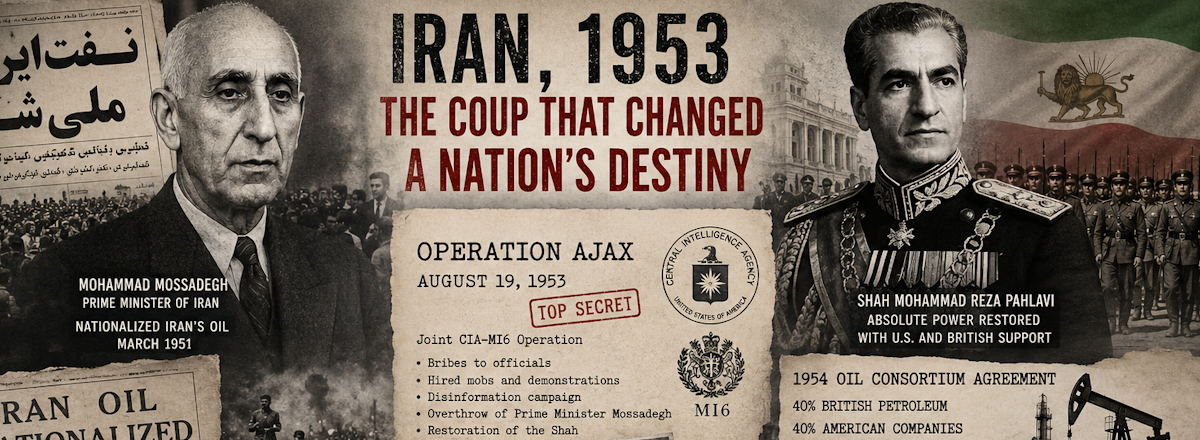
In March 1951, Iran's democratically elected Prime Minister Mohammad Mossadegh nationalized the British-controlled Anglo-Iranian Oil Company (AIOC). This decisive action sought to reclaim Iranian sovereignty over its primary natural resource after years in which Britain reaped enormous profits while returning limited benefits to Iran. Britain retaliated with a severe economic blockade, freezing Iranian assets and orchestrating an international boycott of Iranian oil. As the Iranian economy deteriorated, Western powers chose regime change over negotiation.
On August 19, 1953 (28 Mordad 1332 in the Iranian calendar), the United States and Britain carried out Operation Ajax (TPAJAX), a joint CIA-MI6 covert operation. Kermit Roosevelt Jr. directed the effort on the ground, coordinating bribes to Iranian military officers and politicians, hiring mobs to stage pro-Shah demonstrations, and spreading disinformation through local media. The first attempt on August 15 failed, but the operation on August 19 succeeded. Street battles in Tehran resulted in an estimated 200–300 deaths. Mossadegh was arrested, tried for treason in a military court, imprisoned for three years, and confined under house arrest until his death in 1967.
Declassified official U.S. records leave no ambiguity. The State Department’s Foreign Relations of the United States (FRUS), 1952–1954, Iran, 1951–1954 retrospective volume, and CIA internal histories, released via the National Security Archive, confirm that the operation was carried out under direct CIA direction as official U.S. policy. Historian Ervand Abrahamian, in his authoritative book The Coup: 1953, the CIA, and the Roots of Modern U.S.-Iranian Relations (The New Press, 2013), meticulously documents how control of oil, rather than an imminent communist threat from the Tudeh Party, drove the decision. U.S. officials privately acknowledged the communist danger was exaggerated and used largely as a rhetorical device.
The coup immediately restored absolute power to Shah Mohammad Reza Pahlavi, backed by substantial U.S. military aid and intelligence support. With American and Israeli assistance, the Shah established SAVAK, the secret police organization infamous for systematic surveillance, torture, and elimination of political opponents. The 1954 oil consortium agreement restored foreign operational control over Iranian oil (with 40% going to British Petroleum and 40% to American companies), while Iran retained only nominal ownership and a 50-50 profit split. This arrangement underscored continued external economic dominance.
By undermining Iran’s emerging democratic institutions and imposing a repressive, pro-Western autocracy, foreign intervention created profound and lasting resentment. It convinced generations of Iranians that genuine national sovereignty was incompatible with Western interests. This resentment provided critical fuel for the mass mobilization that erupted in 1978–79. The Shah fled Iran on January 16, 1979; Ayatollah Ruhollah Khomeini returned from exile on February 1, and the monarchy collapsed on February 11, 1979, leading to the establishment of the Islamic Republic.
As Abrahamian and other scholars drawing on declassified records demonstrate, the 1953 coup disrupted Iran’s internal political evolution. It replaced gradual progress toward constitutional democracy with authoritarian rule, radicalized opposition movements, and channelled nationalist grievances into revolutionary and strongly anti-Western forms. The long-term consequences continue to define Iranian politics and U.S.-Iran relations, serving as a textbook case of how foreign meddling in sovereign affairs generates decades of instability and blowback.
References
- Ervand Abrahamian, The Coup: 1953, the CIA, and the Roots of Modern U.S.-Iranian Relations (The New Press, 2013)
- U.S. Department of State, Foreign Relations of the United States, 1952–1954, Iran, 1951–1954 (retrospective volume, Office of the Historian)
- National Security Archive, Declassified CIA documents and internal histories (NSAEBB435, 2013), including The Battle for Iran and Donald Wilber’s “Overthrow of Premier Mossadeq of Iran.”
- Mark J. Gasiorowski, scholarly analyses based on declassified records (various journal articles)
Comments (0)