God and Humans
Leadership, Authority, and the Evolutionary Crisis of Human Consciousness
When the pages of human history are carefully studied, the fact consistently emerges that the seat of power is not just a political or administrative position, but rather it is an insightful reagent for the human personality that brings to the surface the hidden qualities and flaws. The change in human behaviour upon receiving leadership is not a mere coincidence, but is the result of psychological and spiritual stimuli that are activated with the acquisition of power.
Experts in psychology and social sciences agree that the experience of power brings about such changes in human consciousness that have the potential to overwhelm moral instincts.
The basic question is, why does the deterioration develop within a person as soon as he sits on the seat of power that transforms him from a compassionate leader into a tyrannical dictator? Behind this deterioration are three such natural diseases that gradually lead the human consciousness towards a false claim to divinity.
The first disease is ego, which makes a person believe that his insight and decision-making are free from all errors.
The second disease is fear, but this is not an ordinary fear, but the fear of losing his status and position, which makes him an enemy of the just system brought by Allah, because Allah's system cuts off the absolute roots of human sovereignty.
The third disease is self-interest, where the leader spends his power, instead of public welfare, in making self-made laws that only protect his own survival and financial gain.
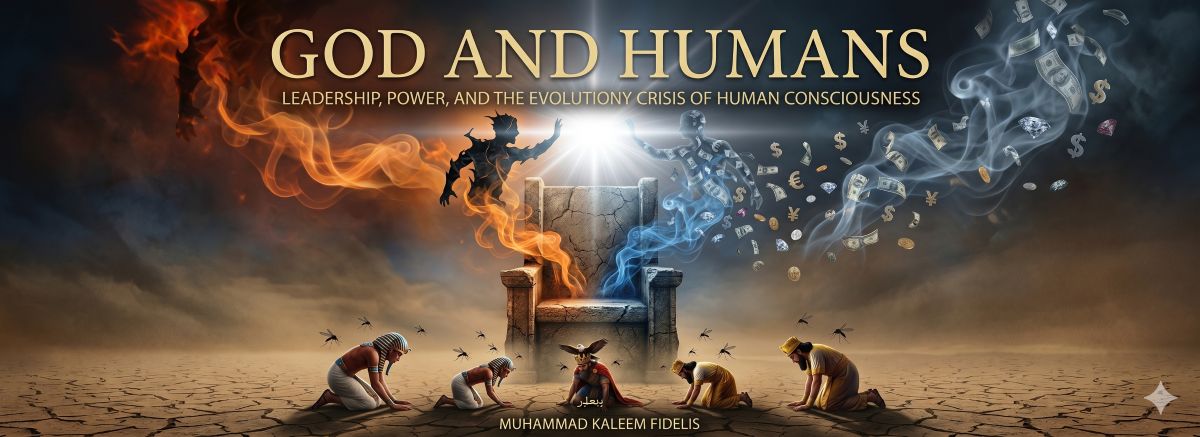
A study of history makes it clear that characters like Pharaoh, Nimrod and Shaddad were initially just powerful leaders, but when these three diseases took root within them, they transcended their human status and claimed to be lords. This book, God and Man, comprehensively covers the psychological, historical and faith-based aspects that are indispensable for understanding this tragedy of leadership. The purpose of this scientific and intellectual endeavour is to determine the causes that push man from the seat of power and into the pit of degradation, where he finds himself in conflict with his Creator.
The Ego's Ascension: The Deception of (I Think Better)
When a leader who is intoxicated with power experiences continuous successes, he develops a feeling of invincibility. In psychology, it is called the syndrome of arrogance. The biggest symptom of this disease is that the leader begins to consider his ideas and decisions as final and free from error. He rejects criticism from others as mere envy, incompetence or conspiracy. At this stage, he begins to consider the process of consultation as a burden, and only those people remain around him who are experts in matching his yes with yes.
Research reports show that a leader suffering from the syndrome of arrogance associates himself with the nation or institution in such a way that he believes that his own interest is actually the interest of the nation. His conversation is dominated by the words "me" and "mine", and he begins to consider himself accountable only to history or some supernatural force, rather than to any human court, which he interprets according to his own wishes.
The prominent symptoms and psychological effects of the syndrome of arrogance
Symptoms
Exaggerated self-confidence
Aversion to criticism
Image obsession
Moral apathy
The Evolution of the Ego: The Journey from Leader to God
When this disease of ego reaches its peak, the leader begins to realize that since he has the resources and the decisions of life and death in his hands, he is a being superior to ordinary humans. The incident of Nimrod is the best example of this, who claimed before Prophet Abraham (peace be upon him) that he too could give life and death, simply because he had the power to kill one of the two prisoners and let the other go. This is the point where the phrase "I think it best" changes to "I am God."
The result of fear: the refuge of oppression and a self-imposed system
Fearful leadership always builds an artificial structure for its own protection. It uses religion for its own purposes or establishes a secular state where God's law has no place. In such a system, the ruler makes laws of his own free will so that no one can challenge his position. Philosophers like Marcellus also spoke of the separation of state and church so that human law can be freely formulated, but oppressive rulers use this freedom to disobey God and serve themselves.
The trap of self-interest and the creation of an exploitative system
The third important dimension of the deterioration of leadership is self-interest. As soon as a person gets leadership, a pile of resources is placed in front of him, and he has to decide whether he will consider these resources as the trust of the nation or his personal inheritance. Unfortunately, people who are raised on a weak moral structure, as soon as they gain power, are caught in the clutches of self-interest.
My advantage lies in the system I create
A self-interested leader will never support a system that is based on transparency and accountability. He will always create complex laws and bureaucratic structures that protect his financial corruption and nepotism. He subordinates the institutions of the state to himself so that the judiciary, police and army all become guardians of his personal interests.
There is also a psychological reason behind this self-interest. The acquisition of power makes him believe that he is above the law. He believes that the principles that apply to others do not apply to him. This is why he begins to consider tax evasion, land grabbing and looting of the national treasury as his right. According to research, the feeling of power reduces a person's capacity for empathy, due to which he ignores the suffering of the poor people and focus only on building his bank balance and his own places.
Shaddad's Paradise: A Metaphor for Material Interest
Shaddad's character is a metaphor for the extremes of material interest and luxury in human history. He tried to build a paradise on earth that was adorned only with gold, silver, and jewels in comparison to Allah's Paradise. Shaddad's real goal was to make people so engrossed in materialistic luxuries that they would abandon their worship of Allah and the Hereafter and become slaves to his system. Even in today's modern era, when rulers deprive the people of their real rights by pursuing cheap privileges and showy projects, they are actually following Shaddad.
Historical Lessons - Pharaoh, Nimrod, and Shaddad
A study of these three historical characters tells us how the deterioration of leadership gradually leads man to the brink of destruction. All three were great leaders at first, but ego, fear, and interest forced them to become Gods.
Pharaoh: The Decline of Political Divinity
Pharaoh's rebellion was not just the rebellion of an individual but represented an entire exploitative system. He divided his people into groups in order to weaken their power. It was the knowledge of his ego that he declared that I am your greatest God. When Prophet Moses (peace be upon him) called him to Allah, he feared that his years of domination would end. He tried to suppress the truth through magicians and propaganda, but ultimately Allah's grip drowned him in the waves of the sea. Pharaoh's tragic end is proof that no matter how powerful the system of oppression is, it cannot stand in the face of truth.
Nimrod: The Pride and Ignominious Death of Human Reason
Nimrod was the first king who intellectually challenged the sovereignty of Allah. He tried to make himself a god through the tricks of the stars and magic. His ego was so great that he took the help of eagles and towers to fight God in the sky, that is, in a fantasy. His debate with Prophet Abraham (peace be upon him) illustrates the perversity of his intellect. To destroy the pride of life and death that he was proud of, Allah appointed a lowly, lame mosquito, which entered his mind and tormented him so much that he was forced to kick his own head in the foot.
Shaddad: The Deception of Material Progress and Sudden Death
Shaddad, relying on the physical strength and wealth of his people, built a city like Iram with pillars of gold. He considered material resources as proof of his divinity. He rejected the advice of Prophet Hud (peace be upon him) with contempt. When the paradise he had built was ready, and he was about to enter it with great arrogance, the angel of death caught him at the door. Neither his interests worked, nor his wealth could save him.
Alternative Model - Leadership as Trust and Service
The only cure for this corruption of power lies in the concept of leadership that Islam has presented. Islam does not define leadership as dominance but as trust.
Understanding Trust and Responsibility
When leadership is considered a test from Allah, humility takes the place of ego. The Messenger of Allah (ﷺ) said that each of you is a guardian and you will be asked about your subjects. This is the concept of accountability that instills the fear of Allah in the heart of the leader at all times. A true leader knows that if he violates the rights of even a single person, he will have to answer to the Lord of the universe.
There are four major pillars of Islamic leadership that can be called models:
Taqwa: The feeling of the presence of Allah at all times.
Competence: The ability to do the job in the best possible way.
Shura: The suppression of one’s ego and consulting others.
Empathy: Putting the needs of the people before one’s own interests.
The Importance of Moral Identity
According to research, for people with a strong moral identity, power awakens a greater sense of compassion and justice. They see power as an opportunity to eliminate injustice from society. In contrast, for those with weak moral foundations, power awakens the hidden Pharaoh within them.
True leadership is one that uses socialized power, that is, power that is used to empower and help others. When a leader sees himself as a servant of the people, he neither fears the loss of his position nor does he create a system for personal gain, because his real interest is in the pleasure of Allah.
Decline of Leadership and Social Anarchy - A Contemporary Perspective
When leadership is imprisoned in the triple siege of ego, fear and self-interest, its impact is n
ot limited to the leader himself, but the entire society is affected by it. The current political disarray and decline of institutions is a manifestation of this Nimrodian psychology, where the purpose of power has become domination instead of service.
Destruction of Institutions and Culture of Fear
A tyrannical leader never allows strong institutions to flourish because independent institutions are an obstacle to his arbitrariness. He paralyzes the judiciary, uses the media to satisfy his ego and makes the bureaucracy his personal slave. The result is a culture of fear where speaking the truth becomes a crime and flattery remains the only way to progress. People start hiding facts that they find unpleasant to please the leader, due to which the leadership becomes completely blind and starts making wrong decisions that ultimately lead to the destruction of the state.
Distance from the divine system and moral bankruptcy
When society abandons God's system of justice and starts following exploitative laws made by humans, then the blessing is removed from there. The corruption of leadership also spreads to the masses, and people also start taking advantage of each other for material interests. This is the point where the relationship between God and man breaks down. When man forgets God, God makes him forget about his own self, and he embarks on a race that has no destination.
The journey from servitude to rule
The path of leadership is actually the path of servitude. Man cannot become a successful leader until he sacrifices his ego before God, replaces his fear with the fear of God, and adapts his interests to the service of God's creation. The examples of Pharaoh, Nimrod and Shaddad have been placed before us so that we may know that when a person transgresses his limits, everything in the universe turns against him, even a small mosquito or a drop of water is enough to destroy him.
The message of God and man in this article is clear: Leadership is a test, not an honour. If you are given power, do not consider it the perfection of your abilities, but consider it a trust from Allah. Overcome your ego with consultation, your fear with trust, and your self-interest with sacrifice. Remember, the system of Allah is the only way that takes man out of the slavery of man and leads him to the servitude of the Creator and true freedom. Those who realize this truth, history remembers them as Abu Bakr and Umar (may Allah be pleased with them), and those who turn away from it remain only as a story of a lesson.
Comments (0)